Showing posts with label Air. Show all posts

Thursday, September 27, 2012

Wind funnel, Science Project

schoolscienceproject.blogspot.in


Wind funnel


Light a candle and blow at it hard through a funnel held with its mouth a little way from the flame. You cannot blow out the flame; on the contrary it moves towards the funnel. When you blow through the funnel the air pressure inside is reduced, and so the air outside enters the space through the mouth. The blow air sweeps along the funnel walls: if you hold the funnel with the edge directly in front of the flame, it goes out. If you blow the candle through the mouth of the funnel, the air is compressed in the narrow spout, and extinguishes the flame immediately on exit.

Floating card, Science Project

schoolscienceproject.blogspot.in


Floating card


Many physical experiments seem like magic, but there are logical explanations and laws for all the strange occurrences. Stick a thumbtack through the middle of a halved postcard. Hold it under a cotton spool so that the pin projects into the hole and blow hard down the hole. If you manage to loosen the card, you really expect into fall. In fact, it remains hovering under the spool. Bernoulli’s law explains this surprising result. The air current goes through at high speed between the card and the spool, producing a lower pressure, and the normal air pressure pushes the card from below against the spool. The ascent of an aeroplane takes place in a similar manner. The air flows over the arched upper surface of the wings faster than over the flat under-surface, and therefore the air pressure above the wings is reduced.

Flying coin, Science Project

schoolscienceproject.blogspot.in


Flying coin


Lay a sixpence or a dime four inches from the edge of the table and place a shallow dish eight: inches beyond it. How can you blow the coin into the dish! You will never do it if you blow at the coin from the front - on the false assumption that the air will be blown under the coin because of the unevenness of the table and lift it up. It will only be transferred to the dish if you blow once sharply about two inches horizontally above it. The air pressure above the coin is reduced, the surrounding air, which is at normal pressure, flows in from  all directions and lifts the coin. It goes into the air current and spins into the dish.

Trapped ball, Science Project

schoolscienceproject.blogspot.in


Trapped ball


Place a table tennis ball in a funnel, hold it with the mouth sloping upwards, and blow as hard as you can through the spout. You would hardly believe it, but nobody can manage to blow the ball
out. The air current does not hit the ball, as one would assume, with its full force. It separates and pushes through the places where the ball rests on the funnel. At these points the air pressure is lowered according to Bernoulli’s law, and the external air pressure pushes the ball firmly into the mouth of the funnel.

Wind-proof coin, Science Project

schoolscienceproject.blogspot.in


Wind-proof coin


Push three pins into the middle of a piece of wood and lay a coin (5 new pence or 25-cents) on top of them. You can make a bet! Nobody who does not know the experiment will be able to blow the coin off the tripod. The metal cannot hold the gust of air on its narrow, smooth edges. The gust shoots through under the coin and reduces the air pressure, forcing the coin more firmly on to the pins. But if you lay your chin on the wood just in front of the coin and blow with your lower lip pushed forward, the air hits the underside of the coin directly and lifts it off.

Bernoulli was right, Science Project

schoolscienceproject.blogspot.in


Bernoulli was right


Lay a postcard bent lengthways on the table. You would certainly think that it would be easy to overturn the card if you blew hard underneath it. Try it! However hard you blow, the card will not rise from the table. On the contrary, it clings more firmly. Daniel Bernoulli, a Swiss scientist of the eighteenth century, discovered that the pressure of a gas is lower at higher speed. The air stream produces a lower pressure under the card, so that the normal air pressure above presses the card on to the table.

Curious air currents, Science Project

schoolscienceproject.blogspot.in


Curious air currents


If you stand behind a tree trunk or a round pillar on a windy day, you will notice that if offers no protection, and a lighted match will be extinguished. A small experiment at home will confirm this: blow hard against a bottle which has a burning candle standing behind it, and the flame goes out at once. The air current divides on hitting the bottle, clings to the sides, and joins up again behind the bottle with its strength hardly reduced. It forms an eddy which hits the flame. You can put out a lighted candle placed behind two bottles in this way, if you have a good blow.

Egg blowing, Science Project

schoolscienceproject.blogspot.in


Egg blowing


Place two porcelain egg-cups one in front of the other, with an egg in the front one. Blow hard from above on to the edge of the filled cup. Suddenly the egg rises, turns upside down and falls into the empty cup. Because the egg shell is rough, it does nor lie flat against the smooth wall of the egg-cup. Air is blown through the gap into the space under the egg, where it becomes compressed. When the pressure of the cushion is great enough, it lifts the egg upwards.

Compressed air rocket, Science Project

schoolscienceproject.blogspot.in


Compressed air rocket


Bore a hole through the cap of a plastic bottle, push a plastic drinking straw through it and seal the joints with adhesive. This is the launching pad. Make the rocket from a four-inch-long straw,
which must slide smoothly over the plastic straw. Stick coloured paper triangles for the tail unit at one end of the straw, and at the other end plasticine as the head. Now push the plastic tube into
the rocket until its tip sticks lightly into the plasticine. If you press hard on the bottle the projectile will fly a distance of 10 yards or more. When you press the plastic bottle, the air inside is compressed. When the pressure is great enough, the plastic straw is released from the plug of plasticine, the released air expands again, and shoots off the projectile. The plasticine has the same function as the discharge mechanism in an airgun.

Blowing trick, Science Project

schoolscienceproject.blogspot.in


Blowing trick


Place a playing card on a wineglass so that at the side only a small gap remains. Lay a large coin (half a dollar or 10 new pence) on the card. The task is to get the coin into the glass. Anybody who does not know the trick will try to blow the coin into the gap from the side without success.
The experiment only works if you blow once quickly into the mouth of the glass. The air is trapped inside and compressed. The increased pressure lifts the card and the coin slides over it and into the glass.

Shooting backwards, Science Project

schoolscienceproject.blogspot.in


Shooting backwards


Hold an empty bottle horizontal and place a small paper ball lust inside its neck. Try to blow the ball into the bottle. You cannot! Instead of going into the bottle, the ball flies towards your face. When you blow, the air pressure in the bottle is increased, and at the same time there is a partial vacuum just inside the neck. The pressures become equalised so that the ball is driven out as from an airgun.

Match lift, Science Project

schoolscienceproject.blogspot.in


Match lift


It is simple, using air, to lift matches from the table into their box. Hold the case between your lips and lower it over the matches. Draw a deep breath, and the matches hang on to the bottom of the case as though they were stuck on. By drawing in breath you produce a dilution of the air, in the case. Air pressure pushes the matches from underneath towards the opening. Even a single match can be raised in this way, if the air is drawn in sharply.

Fountain, Science Project

schoolscienceproject.blogspot.in


Fountain


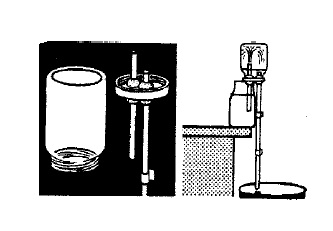
Punch two holes in the lid of a jam jar and push a plastic straw a distance of two Inches through one. Fix three more straws together with adhesive tape and push through the other hole. Seal the joints with warm plasticine. Screw the lid to the jar, which should contain some water, turn it upside down and let the short straw dip into a bottle full of water: a fountain of water rises into the upper jar until the bottle is empty. The water pours out through the long tube, and the air pressure in the jar becomes less. The air outside tries to get in and pushes the water from the bottle.

Weather frog, Science Project

schoolscienceproject.blogspot.in


Weather frog


A tree frog made of paper will climb up and down a ladder like a real weather frog and predict the weather. Bend a 2f-inch-long strip of metal into a U-shape and bore through it so that a sewing needle can be turned easily when inserted through the holes. The needle is made able to grip by heating, and the frog, made from green paper, is fixed on to it by a thin wire. Stick the metal strip firmly on to the middle of the wall of a four-inch-high jar, and at the side a cardboard ladder. Wind a thread round the needle, with a small counterweight at the end. Stick a paper disk on a piece of plastic foil, and draw the other end of the thread through the middle. The foil is stretched over the mouth of the jar so as to be smooth and airtight, the thread is tightly knotted, and the hole sealed. When the air pressure is high (fine weather) the plastic foil is pressed inwards and the frog climbs up. When the pressure is low (bad weather) the pressure on the foil is less and the frog climbs back down.

Bottle barometer , Science Project

schoolscienceproject.blogspot.in


Bottle barometer


Stretch a piece of balloon rubber over the mouth of a milk bottle and stick a straw on top of it. As the air pressure varies daily according to the state of the weather, the end of the straw moves up and down. When the air pressure is higher in fine weather, the rubber is pressed inwards, and the end of the pointer rises. When the air pressure falls, the pressure on the rubber is reduced, and the pointer falls. Because the air in the bottle will expand if it is heated, the barometer should be placed in a spot where the temperature will remain constant.

Weight of air on paper, Science Project

schoolscienceproject.blogspot.in


Weight of air on paper


Lay a cigar-box lid over the edge of a smooth table. Spread an undamaged sheet of newspaper and smooth it firmly on to the lid. Hit the projecting part of the lid hard with your fist. It breaks, without the paper flying up. The lid is only slightly tilted when it is hit. In the space formed between the lid, newspaper and table, the air cannot flow in quickly enough, so that there is a partial vacuum, and the normal air pressure above holds the lid still as if it were in a screw clamp.

Hanging water, Science Project

schoolscienceproject.blogspot.in


Hanging water


Fill a glass to overflowing with water and lay a post cardon it. Support the card with one hand, turn the glass upside down and remove your hand from the card. it remains on the glass, and allows no water to escape.With a glass of normal height, a weight of water of about 2 ounces presses on each square inch of card. On the other hand the pressure of air from below is about one- hundred times as great on
each square inch, and presses the card so firmly against the glass that no air can enter at the side and so no water can flow out

Air lock, Science Project

schoolscienceproject.blogspot.in


Air lock


Place a funnel with not too wide a spout into the mouth of a bottle and seal it with plasticine so that it is airtight. If you pour some water into the funnel, it will not flow into the bottle. The air enclosed in the bottle prevents the water entering. On the other hand, the water particles at the mouth of the funnel, compressed like a skin by surface tension, do not allow any air to escape. Close one end of a straw, push the other end through the funnel, lift your finger, and the water flows at once into the bottle. The air can now escape through the straw.

Balloon in the bottle, Science Project

schoolscienceproject.blogspot.in


Balloon in the bottle


Do you believe that it is always possible to blow an ordinary balloon right up! You will be surprised: push a balloon into a bottle and stretch its mouth-piece over the opening. Blow hard into the balloon. It is only possible to stretch the rubber before your breath runs out. As the pressure of the air in the balloon increases, so does the counter-pressure of the air enclosed in the bottle. It is soon so great that the breathing muscles in your thorax are not strong enough to
overcome it.

Diving bell , Science Project

schoolscienceproject.blogspot.in


Diving bell


You can immerse a pocket-handkerchief in water, without it getting wet: stuff the handkerchief firmly into a tumbler and immerse it upside down in the water. Air is certainly invisible, but it nevertheless consists of minute particles, which fill the available space. So air is also enclosed in the upturned glass, and it stops the water entering. If, however, you push the glass deeper, you will see that some water does enter, due to the increasing water pressure, which compresses the air slightly. Diving bells and caissons, used under water, work on the same principle.